Advanced digital services are no longer confined to metropolitan data centre clusters or hyperscale campuses close to power grids and fibre hubs. As cloud, satellite and data-driven systems expand, the physical infrastructure that supports them is being deployed in increasingly remote and hostile environments, where resilience and continuity matter as much as raw capacity.
That shift is illustrated by the completion of a modular data centre on a remote South Atlantic island by Secure I.T. Environments, delivered for a global telecommunications operator. The facility will support mission-critical ground operations connecting customers to next-generation satellite and subsea backbone services, a layer of infrastructure that underpins modern data-intensive applications across industries.
Located around 1,800 kilometres west of mainland Africa, the island was selected for its strong operating profile for satellite connectivity. Yet its geographic advantages came with severe practical constraints. The site sits on rugged volcanic terrain with no pre-existing access road, minimal local infrastructure and a corrosive coastal climate. Transport was limited to narrow sea freight windows and a single weekly flight, both dependent on weather conditions.
When digital systems depend on physical resilience
Modern data-driven services may be virtual, but the infrastructure that enables them is profoundly physical. Ground stations, subsea landing points and the data centres that support them must operate continuously, often in environments far removed from conventional industrial supply chains.
In this case, the brief called for a high-capacity facility capable of uninterrupted operation despite constant exposure to salt air and ocean spray. Reliability was non-negotiable. Any outage could disrupt critical communications services, with wider consequences for customers and networks that depend on continuous connectivity.
A spokesperson for the telecommunications provider said the complexity of the environment made experience a decisive factor in selecting a delivery partner. The emphasis was on detailed planning, adaptability and risk management rather than speed alone. Secure I.T. Environments supported the client through the design phase and developed a delivery and installation plan focused on minimising operational risk.
Logistics as a core design challenge
One of the defining features of the project was the scale of logistical coordination required. With a small island population, successful delivery depended on close cooperation with the local community. Hotel operators, logistics workers and local services all played a role, creating employment opportunities and a sense of shared involvement in a high-tech project.
Every stage of construction had to be aligned with the island’s limited transport links. Personnel movements, equipment deliveries and installation schedules were planned around the single weekly flight and infrequent shipping access, both vulnerable to disruption from unpredictable weather.
These constraints shaped the engineering approach. Modular, containerised construction reduced the amount of on-site work required and limited exposure to delays. Factory testing became essential, ensuring systems would perform as expected once deployed, with minimal need for troubleshooting in a remote location.
Engineering for isolation and continuity
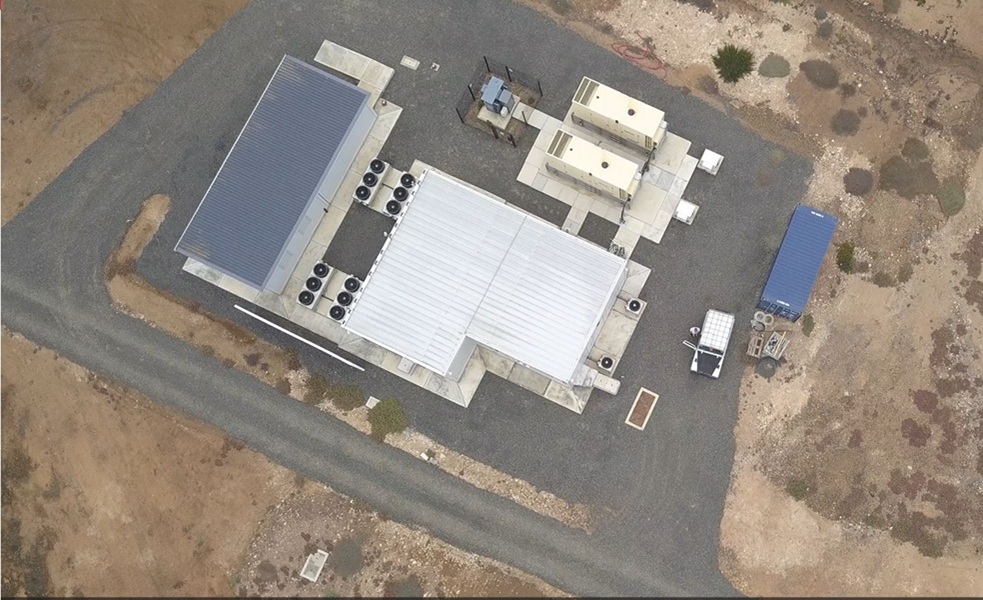
From initial design discussions to final commissioning, the project took 12 months and was completed on time. Secure I.T. Environments designed, manufactured, pre-built and factory-tested a multi-container modular facility comprising a main data room, a dedicated UPS and switch room, and associated lobby space.
The facility was engineered specifically for the island’s conditions. This included specially adapted air-conditioning condensers, protective coatings and materials selected to withstand high salinity levels and continuous exposure to ocean spray. High-density IT racks were deployed with cold-aisle containment, supported by N+1 energy-efficient cooling and modular N+1 uninterruptible power systems.
Custom switchgear, fire detection and suppression, security systems including CCTV and access control, fibre raceways and full electrical infrastructure were integrated into the design. All modules underwent integrated systems testing in the UK before shipment, ensuring seamless assembly and performance alignment once installed on the island.
Chris Wellfair, projects director at Secure I.T. Environments, said the project tested every aspect of delivery, from logistics to engineering, and demonstrated the value of modular design and close client collaboration in extreme conditions.
What this signals for future infrastructure
While the facility supports satellite and subsea communications, its implications extend beyond a single deployment. Data-driven services increasingly depend on resilient networks that operate far outside traditional data centre geographies, often in locations chosen for strategic connectivity rather than convenience.
As digital workloads grow in scale and complexity, infrastructure is following them into harsher and more isolated environments. In these settings, modularity, environmental hardening and rigorous pre-testing are becoming essential capabilities.
The South Atlantic project is a reminder that the future of advanced digital systems will be shaped not only by software and platforms, but by the ability to build and operate critical infrastructure wherever it is needed, even at the edge of the map.