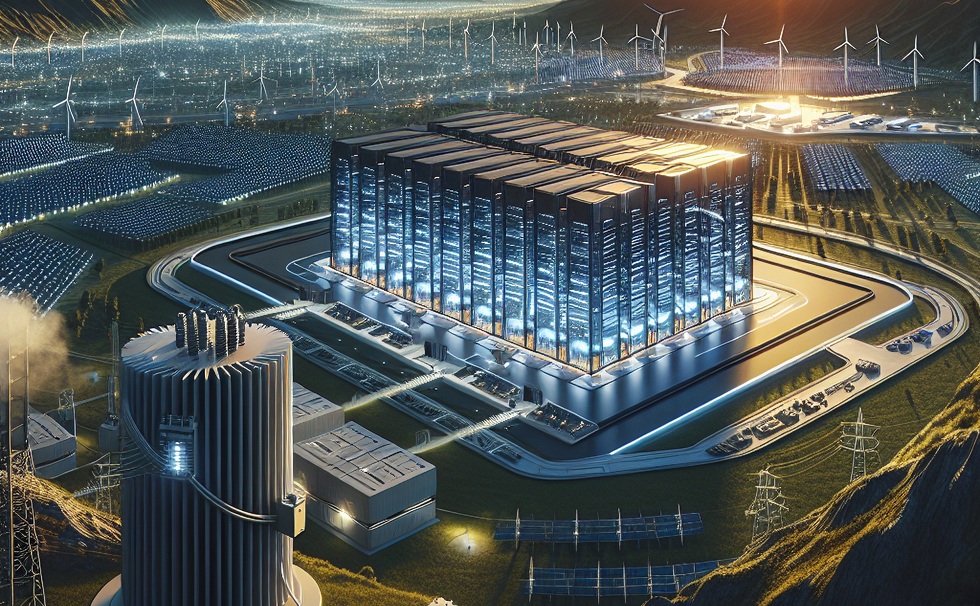
The global race to scale artificial intelligence is no longer being decided by models or software, but by energy systems and infrastructure discipline. In Scandinavia, those forces have aligned to create a region where AI growth and sustainability are not in conflict but engineered to reinforce each other.
The narrative around artificial intelligence has been dominated by models, chips and capital, but the physical reality is far less abstract. AI has become an industrial system, and like every industrial system before it, it is constrained by energy, geography and the limits of infrastructure. That shift is beginning to redraw the global map of where AI can scale.
Scandinavia sits at the centre of that realignment. Not because it set out to lead in artificial intelligence, but because it has spent decades building the conditions that AI now requires. Renewable energy at scale, stable grid infrastructure, predictable regulation and a culture of long-term industrial planning have converged at precisely the moment when AI demands all four.
Thierry Chamayou, Vice President of Cloud and Service Providers for EMEA at Schneider Electric, frames the transformation in practical terms. “The Nordic regions have demonstrated what happens when energy policy, digital ambition and industrial pragmatism all pull together,” he says. “By aligning renewable buildout, grid planning and digital strategies, governments have made the region a natural home for AI infrastructure. Abundant low carbon electricity from hydro, wind and in some markets nuclear gives AI factories a structural emissions advantage from day one.”
That alignment is not theoretical. It is visible in the scale and type of infrastructure now being built across Norway, Sweden and Denmark. Operators are no longer positioning sustainability as a constraint to be managed, but as an enabling condition that reduces cost, improves efficiency and accelerates deployment timelines.
“That combination has turned Scandinavia into a strategic destination where AI growth and climate targets reinforce each other, not collide,” Chamayou continues. “Operators such as Green Mountain and EcoDC turn these strengths into delivery by using one hundred percent renewable power with advanced cooling and heat reuse projects to deliver AI ready capacity with low emissions and high efficiency built for AI at scale.”
The implication is significant. In most markets, sustainability remains a compliance issue or a reputational concern. In Scandinavia, it has become a structural advantage.
Energy defines the map
The global expansion of AI infrastructure is often described as a continuation of the cloud era, but the underlying dynamics have changed more fundamentally than that. AI workloads demand far greater power density, operate continuously and require infrastructure that can scale rapidly without compromising stability.
John McWilliams, Head of Data Center Insights at Cushman and Wakefield, places the current investment cycle into context. “It is off the charts compared to anything that we have seen in the past,” he says. “Ten years ago, we had just under one gigawatt under construction in the Americas. Today, that figure is over twelve gigawatts, with more than eighty gigawatts in the planning pipeline. It is a significant increase in activity across every region.”
That surge in demand is exposing a simple constraint. AI does not scale where land is available or where capital is cheapest. It scales where power can be delivered quickly, reliably and at a cost that supports the economics of training and inference.
“It is one hundred percent speed to power,” McWilliams says. “If you can offer a hyperscaler or an AI company the ability to get a facility up and running within twelve to eighteen months, that is going to be far more attractive than waiting five to seven years for power in a new build scenario.”
This is where Scandinavia’s advantage becomes decisive. The region is not only rich in renewable energy, but its grids are already built to handle large-scale industrial demand. That combination reduces both the cost of electricity and the uncertainty around delivery timelines.
The difference is visible in pricing. Across Europe, power costs vary dramatically. The CBRE European market overview shows Nordic power prices ranging from €0.02 to €0.15 per kWh, compared with €0.10 to €0.26 in major FLAPD markets such as London, Frankfurt and Amsterdam. That differential alone is enough to reshape investment decisions at scale.
The result is a geographic shift that mirrors the underlying physics. AI training workloads, which are less sensitive to latency, are moving away from traditional hubs and towards regions where energy is abundant and affordable.
Infrastructure built for density
The nature of AI infrastructure is also changing. High density compute is forcing a redesign of how data centres are built, cooled and operated. The assumptions that defined the cloud era no longer hold.
Chamayou highlights the engineering implications. “The Nordic climate allows data centres to utilise air, lake water and seawater cooling much further than in most markets, reducing reliance on energy intensive mechanical cooling,” he explains. “That is a substantial advantage for dense AI clusters, but it comes with its own engineering requirements.”
Those requirements are not trivial. Operating in extreme climates introduces new variables that must be managed at scale. Equipment must perform reliably at low ambient temperatures, avoid icing and maintain stability as seasonal conditions change.
“Power and cooling equipment must be designed to operate reliably at very low temperatures, protect against icing and manage seasonal transitions without thermal stress on critical components,” he adds. “Digital design tools, simulation and continuous monitoring are essential to avoid hotspots and stranded capacity as weather and IT loads change.”
The sophistication of that approach reflects a broader shift in how infrastructure is conceived. AI data centres are no longer static assets. They are dynamic systems that require constant optimisation across energy, cooling and compute.
This is reinforced by the scale at which facilities are now being developed. McWilliams describes a market where projects routinely exceed historical norms. “What we are seeing now are campuses that can reach several hundred megawatts, even approaching a gigawatt in some cases,” Chamayou continues. “These are built in phases over years, but the overall scale is much larger than anything we have seen before.”
That scale places additional pressure on energy systems, but it also creates opportunities to integrate new approaches to efficiency and sustainability.
Beyond headline metrics
The discussion around sustainable infrastructure has often been reduced to a small number of metrics, most notably power usage effectiveness. In Scandinavia, that conversation is becoming more nuanced.
Chamayou is direct on the limitations of single metrics. “In very efficient, cold climate facilities that use extensive free cooling and heat reuse, a PUE around 1.1 is realistic for top tier sites. Going significantly below that usually adds cost and complexity and can shift impact elsewhere in the lifecycle.”
The more meaningful shift is towards a broader set of indicators that reflect the full environmental and operational impact of AI infrastructure. “The real maturity is moving beyond one headline number toward portfolios of metrics that include energy efficiency, carbon intensity, water use, embodied carbon and circularity, reported through standard and verifiable frameworks aligned with EU initiatives on data centre sustainability,” he says.
That approach reflects a deeper integration between energy systems and digital infrastructure. It also aligns with regulatory trends that are pushing for greater transparency and accountability across the lifecycle of data centre operations.
A regulatory environment that enables rather than restricts
Regulation is often cited as a barrier to infrastructure development in Europe, but in Scandinavia it has played a different role. Rather than slowing deployment, it has created a predictable framework that supports long-term investment.
Chamayou points to the combination of transparency and alignment with broader European standards. “Operators benefit from a relatively predictable regulatory environment and a culture of transparency around energy and sustainability data, which aligns with European rules like GDPR and the emerging EU data centre sustainability framework.”
That predictability reduces risk for investors and operators, particularly in a market where timelines and capital requirements are already stretched. It also supports the development of integrated energy and digital systems, which are increasingly essential for managing AI workloads.
At the same time, the region has avoided some of the bottlenecks that are emerging in more established markets. In parts of Europe, grid constraints and permitting delays are extending timelines to the point where they become commercially unviable. Scandinavia’s infrastructure has been built with a different time horizon in mind.
Capital follows capability
The flow of capital into AI infrastructure reflects these structural advantages. Investors are increasingly prioritising regions where power availability, cost and regulatory clarity reduce execution risk.
McWilliams describes a market where demand is expanding beyond traditional centres. “We are seeing development radiate out from primary markets into secondary and tertiary locations. A lot of that is driven by land economics, but increasingly it is about where you can get power within a reasonable timeframe.”
In Europe, that dynamic is reinforced by the cost differential between regions. As the CBRE data shows, Nordic markets offer a combination of low energy costs and growing capacity that is difficult to replicate elsewhere .
The result is a concentration of AI training infrastructure in locations that would previously have been considered peripheral. At the same time, inference workloads and latency-sensitive applications continue to anchor closer to population centres, creating a more distributed and layered infrastructure landscape.
Lessons beyond the Nordics
The question is whether Scandinavia’s model can be replicated elsewhere. The answer is both yes and no. Chamayou distinguishes between what is unique and what can be transferred. “What is uniquely Nordic is the precise mix of cool climate, very high renewable penetration, long-term planning culture and mature grid conditions. What can be replicated is the engineering rigour, the integration of energy and digital planning and the conviction that AI growth must be compatible with sustainability objectives.”
That distinction matters. Not every region can replicate the natural advantages of Scandinavia, but the underlying approach to infrastructure design and energy integration can be applied more broadly.
It also suggests that the competitive landscape for AI infrastructure will be shaped less by isolated factors and more by the coherence of entire systems. Regions that align energy policy, industrial strategy and digital infrastructure will be better positioned to capture long-term investment.
The industrialisation of AI
The emergence of Scandinavia as a hub for AI infrastructure is not an anomaly. It is an early example of a broader shift in how artificial intelligence is being deployed.
AI is moving from a software-driven paradigm to an industrial one. It requires physical assets, energy systems and operational models that resemble traditional industries more than digital services.
That transition brings with it a different set of constraints and opportunities. It also exposes the gap between ambition and execution in markets that have focused on policy and innovation without addressing the underlying infrastructure.
The Nordic region has taken a different path. By building the conditions that AI now depends on, it has created a platform where growth can be sustained rather than constrained.
The implications extend beyond geography. They point to a future where the success of AI is determined not by the sophistication of models, but by the ability to deliver energy, infrastructure and systems at scale.
Scandinavia has not just positioned itself as a destination for AI infrastructure. It has demonstrated what that infrastructure must look like when sustainability, efficiency and scale are treated as engineering problems rather than marketing claims.
The rest of the world is now being forced to catch up.