
The rapid expansion of artificial intelligence is forcing data centre operators to reconsider how they design cooling infrastructure, particularly as facilities increasingly need to accommodate a mixture of conventional computing equipment and high-density AI workloads.
While liquid cooling is becoming an important component of AI infrastructure, the transition from traditional air-cooled environments is rarely straightforward. Operators must balance the demands of existing equipment with the thermal requirements of new computing systems, often before the final configuration of a data hall has been established.
Schneider Electric’s latest addition to its Motivair liquid cooling portfolio addresses this challenge through a hybrid approach that allows operators to combine air and liquid cooling without committing to a fixed configuration from the outset.
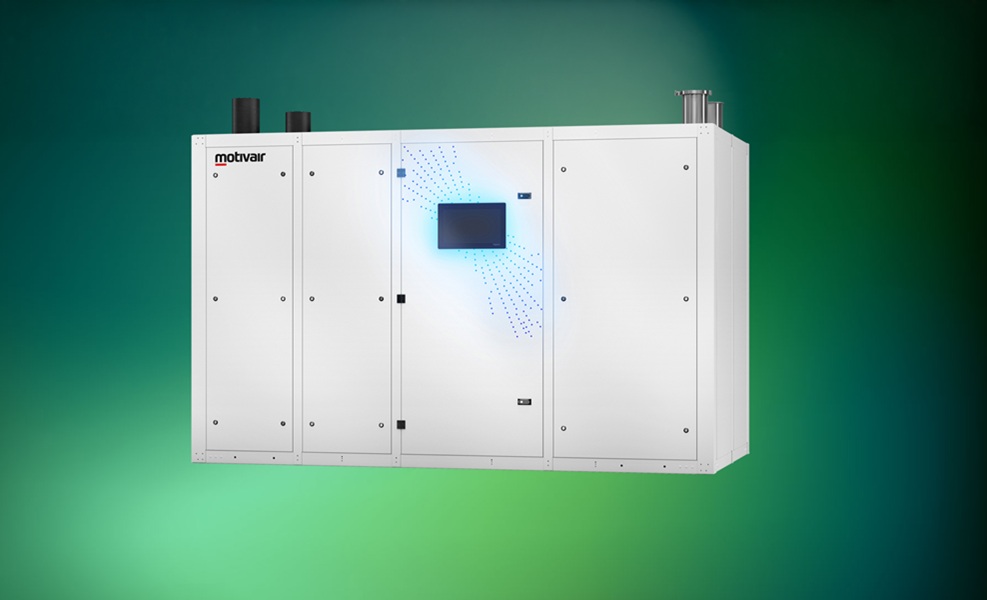
The company has introduced the WCDU, a coolant distribution unit designed to integrate with fan wall air-cooling systems while supporting high-density liquid cooling deployments. The system provides cooling capacity of up to 3.5MW from a single unit and is intended to give operators greater flexibility as AI workloads and infrastructure requirements evolve.
The announcement reflects a wider engineering challenge facing the sector. As demand for AI computing increases, cooling infrastructure must accommodate substantial changes in equipment density without creating unnecessary capacity or requiring extensive redesign whenever technology requirements change.
The challenge of designing for uncertain AI demand
One of the difficulties confronting data centre developers is determining how much liquid cooling capacity to install when the eventual mix of computing workloads may still be uncertain.
Installing too much infrastructure creates the risk of stranded capacity, while designing exclusively around current requirements can make subsequent expansion more complicated.
Schneider Electric’s WCDU has been developed to address this issue by allowing operators to adjust the balance between air and liquid cooling without completely redesigning the data hall.
The system can operate independently or integrate with existing fan wall configurations, providing a potential route for operators looking to retrofit facilities originally designed around air cooling.
Another important aspect of the design is its location. Rather than placing coolant distribution units within the main IT space, the WCDU has been optimised for installation in technical corridors, with top-entry connections intended to simplify installation and maintenance access.
Moving cooling equipment outside the main computing environment also helps preserve space for IT infrastructure, an increasingly important consideration as operators seek to accommodate more demanding AI systems within existing facilities.
Cooling capacity becomes an infrastructure constraint
The scale of cooling required for high-density AI environments is reflected in the technical specifications of the new system.
A single WCDU can deliver up to 3.5MW of cooling capacity at a flow rate of 1.5 litres per minute per kW, or 2.5MW at 2.0 litres per minute per kW. Up to 20 units can operate together as a coordinated system, supporting the scale required for data halls with capacities of 30MW to 40MW.
The design incorporates pumps, heat exchangers and other essential components within a single steel frame. It also supports zero lateral clearance, allowing units to be installed in space-constrained environments.
Energy efficiency remains another consideration as operators seek to manage the electricity consumption associated with AI infrastructure.
The WCDU supports warmer facility water temperatures and approach temperature differences as low as 2°C, which Schneider Electric says can improve overall cooling efficiency and contribute to lower power usage effectiveness (PUE) and operating costs.
For deployments of up to 2.5MW, the system can also be specified with N+1 redundancy, providing backup pumps and valves to help maintain cooling availability during maintenance or component failure.
Flexibility becomes central to AI infrastructure planning
The development illustrates how cooling architecture is evolving alongside the computing systems it supports.
Rather than treating air and liquid cooling as competing technologies, infrastructure providers are increasingly developing systems that allow both approaches to operate within the same facility.
Andrew Bradner, Senior Vice President of the Cooling Business at Schneider Electric, said the integrated approach was intended to provide greater deployment flexibility while supporting different liquid cooling configurations.
“This approach allows operators to deploy more efficiently, support a wider range of liquid cooling infrastructure configurations, and significantly reduce time to deployment,” he said.
The WCDU extends Schneider Electric’s Motivair coolant distribution portfolio to cover capacities ranging from 105kW to 3.5MW. Initial shipments are scheduled for selected regions in October 2026, with US pre-orders beginning in early 2027.
For data centre operators, the significance extends beyond the introduction of another cooling product. As AI hardware continues to reshape infrastructure requirements, the ability to accommodate changing thermal loads without repeatedly rebuilding the underlying facility is becoming an increasingly important consideration.
The challenge is not simply providing enough cooling for today’s most demanding AI systems, but developing infrastructure that can adapt as computing architectures, rack densities and operational requirements continue to change.