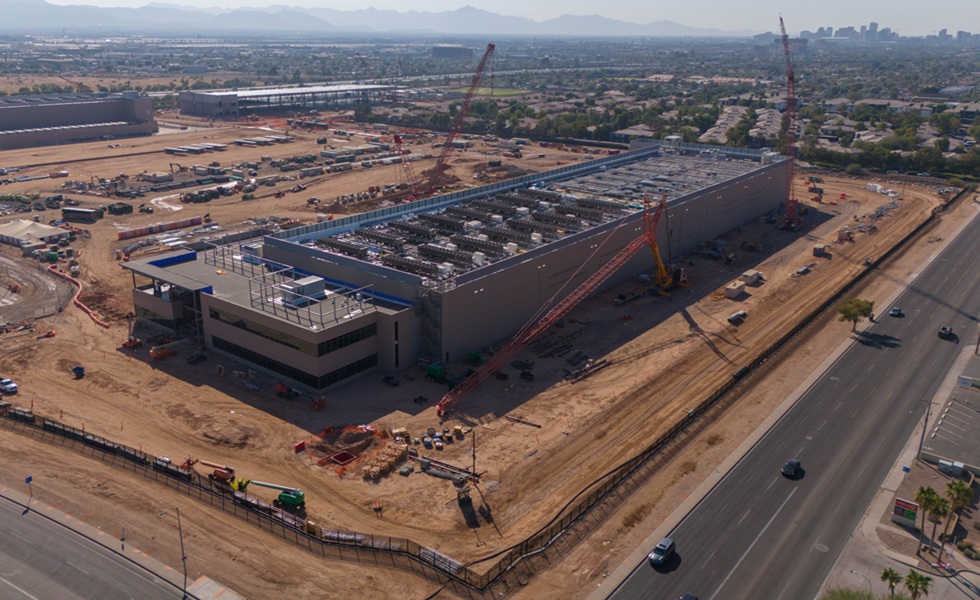
Strategic location, renewable infrastructure and AI-specific design converge at a new European hub that challenges assumptions about what data centers can be. With the rise of generative AI, the question is no longer just how fast or big a data campus can grow, but how responsibly it can evolve.
The AI revolution demands a physical form, and it is taking shape in a quiet coastal town on the westernmost edge of Europe. Sines, Portugal, is home to Start Campus, a 1.2GW data center development redefining how infrastructure should support the future of artificial intelligence. In a sector dominated by talk of scale, speed, and energy, Start Campus adds a rare dimension: sustainability as a first principle, not an afterthought.
Start Campus is not a typical hyperscale build. It is a multi-phase, AI-ready ecosystem designed from the seabed up to reflect the demands of a generative AI world. Its lead project, Sines 01, went live in late 2024 with 14MW of IT load, scaling to 26MW. But this is only the prelude. The whole Campus will deliver six buildings and 1.2GW of capacity, with construction for the next phase breaking ground in late 2025.
Its location is not accidental. Sines lies at the intersection of several transatlantic subsea cable routes, providing the low-latency connectivity that generative AI and machine learning workloads increasingly demand. This makes it not just a place of storage and processing, but of real-time intelligence exchange between continents. The geography, long considered peripheral to Europe’s digital core, becomes an asset when latency and bandwidth define competitive advantage.
It is also a site of historical transformation. Where once coal-fired power defined the local economy, renewable energy and digital infrastructure now take place. This is infrastructure recycling on an industrial scale, where obsolete energy assets are not demolished, but reimagined. Cooling pipes that once supported fossil fuels now feed liquid-cooled racks. Substations, once aligned to combustion, now support computation.
There is a more profound symbolism in this transition. As AI accelerates the pace of global industrial change, the infrastructures that support it must also evolve. Start Campus is not merely a host to AI workloads. It is an embodiment of the shift from carbon-heavy, resource-intensive growth models to ones that prioritise efficiency, resilience, and circularity. In Sines, the future of AI is grounded in the legacy of the past but oriented unflinchingly toward what comes next.
Designing for the exponential era
The driving force behind Start Campus is not just demand from hyperscalers and AI developers, but a profound shift in what data infrastructure must be. Rack densities that once topped out at 5kW now exceed 100. Thermal Design Power (TDP) ratings for GPUs have jumped from 250 watts to over 1000 watts in under five years. This exponential curve is echoed in chip design and the sheer mass of data generated by AI, IoT, and machine-to-machine communication.
“We are seeing exponential growth in AI data and power requirements,” Omer Wilson, Chief Marketing Officer at Start, explains. “What used to be 1.4MW for an entire facility is now 57MW per data hall. These loads are not just increasing in volume, they are changing the entire topology of data center design.”
Start Campus has embraced this shift through a layered infrastructure approach. New buildings are designed to accommodate up to 120kW per rack. Liquid cooling is deployed from day one. Power distribution is engineered for modular scaling. The goal is not just to catch up with AI, but to enable its next wave.
Cold water, hot chips
The heart of Start Campus’s technical achievement is its seawater cooling system. Using infrastructure repurposed from a decommissioned coal power plant, the campus channels ocean water through a closed-loop system, dissipating heat from high-density racks with zero water consumption.
“PUE has become a misleading metric when not paired with water usage,” Rob Dunn, Chief Executive Officer, says. “We are achieving a PUE of 1.1 without evaporative cooling. That is only possible because we do not use fresh water at all. We draw seawater, pass it through a heat exchanger, and return it to the ocean slightly warmer.”
The system is massive in scope. Once fully operational, it will circulate 1.4 million cubic metres of water daily. It is not only environmentally efficient but operationally pragmatic. The infrastructure was already present, the regulatory framework was robust, and the ocean was not a finite resource like groundwater.
A living ecosystem for AI
The result is not just a data center, but a deliberately constructed AI ecosystem. The site is integrated with dark fibre routes and renewable energy projects, with a secured grid connection capacity for the full 1.2GW. The Campus itself is designed as a modular organism, able to evolve with each phase.
The team behind Start Campus is equally global and local. More than 60 people from across Europe have been brought together to lead operations, construction, and design, while Portuguese contractors and partners handle much of the on-the-ground delivery. It is a high-trust model: robust financing from Pioneer Point and Davidson Kempner backs long-term investment, but the operating model is built around flexibility, not rigidity.
This adaptability is central to AI readiness. High-density compute demands not just power and cooling, but configurability. Customers require monitoring at the chip and rack levels. Edge and cloud workloads must coexist within the same footprint. As Wilson puts it, “The real intelligence in AI infrastructure is not just in the power supply or the cooling system. “It is in the ability to reconfigure, optimise, and learn from the way workloads behave.”
Sustainability as infrastructure
Sustainability is often an afterthought in data center projects. At Start Campus, it is a strategic foundation. The site was selected partly because of the opportunity to reuse industrial infrastructure and reduce embodied carbon from the outset. Emissions tracking extends to scope 4, monitoring what is consumed and what is avoided through design and procurement decisions.
India Branquinho de Oliveira, Sustainability Manager, describes the model as “embedding sustainability at every level, from design and operations through to education and community engagement.” This includes a wide range of initiatives: a liquid cooling lab for collaborative R&D, a master’s degree programme in sustainable data center operations, biodiversity and habitat restoration projects, and the use of HVO biofuel for backup generators. These are not gestures; they are designed to scale as the Campus grows.
“We are not just mitigating impact, we are regenerating ecosystems,” Branquinho de Oliveira adds. “We have already translocated endangered flora and restored protected habitats. Our offsets are local, our goals are aligned with the UN Sustainable Development Goals, and our partnerships with science institutions ensure we go beyond compliance.”
The intelligence behind the infrastructure
Supporting this layered design is a foundational collaboration with Schneider Electric, whose infrastructure solutions underpin the operational intelligence of Sines 01. From low- and medium-voltage distribution to thermal monitoring and AI-optimised UPS systems, the facility leverages a suite of technologies to manage increasing density, efficiency and uptime demands. These are not bolt-on utilities, but embedded elements of a data centre architecture built specifically for GPU-accelerated and AI-intensive workloads.
The integration of real-time data via Schneider Electric’s EcoStruxure platform allows Start Campus to monitor and adapt operations dynamically, from energy usage to power resilience. More than hardware, it is a framework for insight, extending from the chip level to the campus grid. Paired with sustainability consulting and power procurement strategies, this operational layer ensures that energy efficiency is not merely an engineering metric, but a business asset. In this model, infrastructure is not passive, it is responsive, learning, and evolving in line with the AI systems it supports.
The edge is not the periphery
There is an irony in calling Sines the edge. Physically, it is peripheral: a quiet coastal town far from the traditional hubs of Frankfurt, London or Amsterdam. But strategically, it may prove central to the next era of AI.
The world is not short of data; it is short of places to put it. Start Campus is not just building space for AI; it is building a sustainable framework for it to live, breathe, and evolve. In doing so, it poses a question that every executive deploying AI at scale will need to answer: What does a responsible AI infrastructure really look like?
If AI is to transform industries, it will require more than cloud contracts and chipsets. It will require land, water, power, and the ability to use them intelligently. The future of AI is not abstract. It is concrete, steel, and seawater. And it is already humming on the Atlantic coast.