The rapid expansion of AI infrastructure has exposed an uncomfortable truth. Building larger data centres is becoming less of a technical challenge than finding enough electricity to power them, forcing operators to rethink their relationship with the grid itself.
When people think about resilience in a data centre, they usually picture what happens when the lights go out. Backup generators start, critical systems remain online and operations continue uninterrupted. It is a model that has served the industry well for decades. Yet as AI drives unprecedented demand for compute capacity, resilience is no longer simply about surviving a power outage. The much bigger challenge is ensuring enough electricity exists in the first place to support the next generation of AI infrastructure. That subtle shift changes almost everything, from how facilities are designed to how operators engage with utilities and governments.
Equinix’s recent hydrogen pilot at its Dublin DB3 facility illustrates that changing mindset. On the surface, the project appears to be an evaluation of hydrogen as an alternative to diesel backup generation. In reality, it is exploring something considerably more significant. Rather than asking how data centres can operate independently of the grid during an emergency, the trial asks how digital infrastructure can become a more intelligent participant in the energy system itself. That distinction has profound implications for AI infrastructure as electricity becomes the defining constraint on future growth.
From backup power to energy strategy
Peter Lantry, Managing Director of Equinix Ireland, believes much of the discussion around hydrogen has focused on the wrong question. “The long-term value of hydrogen is not simply replacing diesel generators,” he explains. “It is really about energy storage. If countries are serious about building electricity systems that rely on renewable energy, they also must become serious about storing that energy. Renewable generation is intermittent by nature, so the countries that ultimately succeed will be the ones that solve storage.”
That observation moves the conversation well beyond backup power. Hydrogen is not interesting because it is another fuel. It is interesting because it has the potential to connect two of the biggest infrastructure challenges facing AI today: rapidly increasing electricity demand and rapidly expanding renewable generation.
Ireland provides an unusually clear example of why that relationship matters. The country has ambitious renewable energy targets while simultaneously hosting one of Europe’s highest concentrations of data centres. Those two developments are often portrayed as being in conflict, yet Lantry argues that the situation is considerably more nuanced. The problem is not simply producing enough electricity. It is producing it at the right time, in the right place and in a form that can be used efficiently.
“At certain times of the day we have more renewable electricity available than the grid can use,” he says. “If that power cannot be consumed, it is curtailed. Instead of wasting it, why not convert it into hydrogen, store it and use it later when demand increases? Once you begin thinking about hydrogen in that context, it becomes part of the wider electricity system rather than just another fuel.”
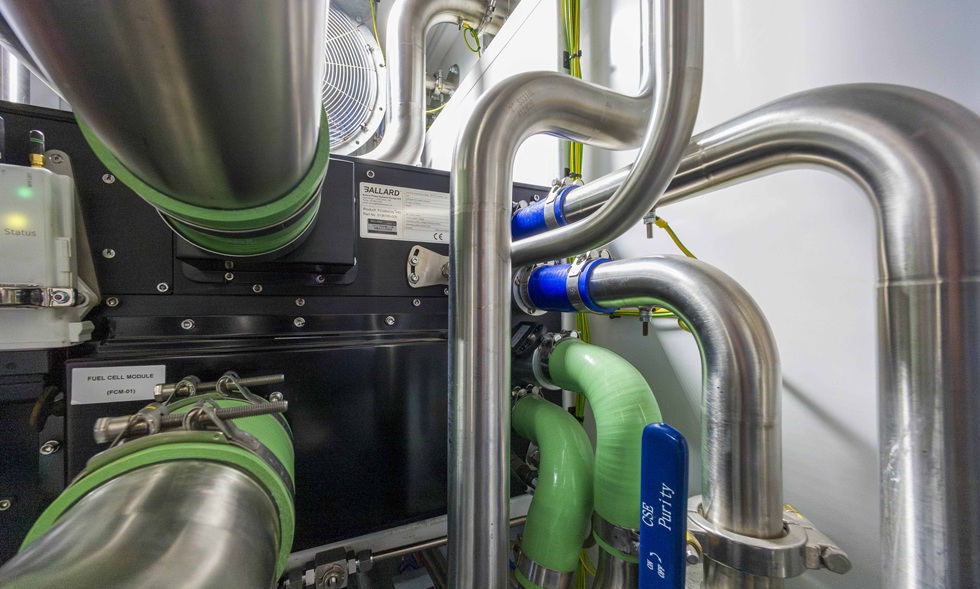
That philosophy underpins the Equinix trial. Conducted in partnership with ESB and GeoPura, the 12-week demonstration is evaluating how hydrogen fuel cells perform in a live operational environment while generating practical data on safety, reliability, efficiency and grid interaction. Rather than creating an isolated technology showcase, the objective is to understand how hydrogen could contribute to a broader energy ecosystem that supports future digital infrastructure.
Why AI is changing the relationship with the grid
The choice of Ireland was equally deliberate. Grid constraints around Dublin have become one of the defining challenges facing new data centre development, with available electricity proving every bit as important as planning permission or land availability. Lantry sees that not as a uniquely Irish problem but as an early indication of what many developed economies will encounter as AI deployment accelerates.
“Ireland is experiencing these challenges earlier than many other countries, but I do not think we are unique,” he says. “AI is increasing electricity demand everywhere. The grid is going to become the limiting factor for future data centre growth unless we start thinking differently about how infrastructure interacts with it.”
That interaction represents one of the most important shifts currently taking place within the industry. Historically, utilities generated electricity while data centres consumed it. Their relationship was largely transactional. AI changes that equation because the scale and consistency of demand mean operators are becoming increasingly important participants in national energy systems.
Lantry describes this as becoming a “good grid citizen”. Instead of drawing electricity whenever it is required, future facilities could actively support grid stability by storing energy when renewable generation is abundant and reducing demand during periods of peak consumption. Hydrogen, batteries and intelligent energy management systems could all contribute to that objective, with each technology performing a different role depending on operational requirements.
“There is no single technology that solves this,” he says. “It will be a mixture of batteries, hydrogen and conventional grid supply. The important thing is understanding how they work together to support both the data centre and the electricity network.”
That balanced perspective is refreshing at a time when many discussions around AI infrastructure search for a single breakthrough technology. Lantry is careful not to present hydrogen as a universal solution. Instead, he repeatedly returns to the importance of flexibility and system optimisation. Hydrogen makes sense where renewable electricity would otherwise be wasted. Batteries excel at responding quickly to short-term fluctuations. Conventional grid supply remains the most efficient option whenever renewable electricity is immediately available.
The pilot itself reflects that pragmatic approach. Rather than attempting to power an entire data centre, Equinix chose to connect the hydrogen units to the site’s cooling infrastructure. Cooling is mission critical, making it an ideal environment for evaluating operational performance without introducing unnecessary complexity. The trial also produced unexpected operational benefits beyond demonstrating reliable power delivery.
Running the hydrogen units reduced the site’s measured power usage effectiveness to below 1.3 while simultaneously producing water as a by-product of the fuel cell process. That water could then be recovered and reused within the cooling system, creating an additional efficiency gain beyond the electricity itself.
Building infrastructure that supports the energy system
Perhaps the most revealing aspect of the interview, however, is Lantry’s willingness to discuss the practical barriers that remain. Green hydrogen is still relatively expensive. Ireland currently imports the fuel used in the trial because domestic production has yet to develop at meaningful scale. Transportation infrastructure remains immature, while government policy and commercial models continue to evolve. None of these challenges can be solved by technology alone.
“There are several things that have to come together,” he explains. “Government policy, renewable generation, hydrogen production, transportation infrastructure and commercial incentives all have to develop together. This is not something one company can solve independently.”
That emphasis on collaboration is increasingly characteristic of the AI infrastructure sector. As facilities become larger and more power intensive, operators are finding that many of their biggest challenges extend well beyond the data centre fence. Electricity networks, planning policy, renewable energy development and industrial decarbonisation are becoming interconnected issues requiring equally integrated solutions.
The Equinix pilot therefore represents something more significant than a successful technology demonstration. It signals a change in how leading operators are thinking about their role within national infrastructure. Rather than treating electricity as a commodity purchased from the grid, they are beginning to explore how digital infrastructure can contribute to the performance and resilience of the grid itself.
Whether hydrogen ultimately becomes a mainstream component of future data centres remains uncertain. Lantry himself is cautious about making such predictions. He sees hydrogen as one tool among many, with adoption depending on local energy markets, renewable generation and national policy rather than any universal blueprint.
“I do not think hydrogen becomes the answer everywhere,” he concludes. “I think it becomes one of the tools available depending on the circumstances. The future is going to be about combining different technologies to support the grid while supporting the growth of digital infrastructure.”
That may prove to be the most important lesson from Dublin. AI is forcing the industry to reconsider assumptions that have remained largely unchanged for decades. The next phase of infrastructure development will not be defined solely by faster processors or denser GPU clusters. It will also depend on how intelligently those facilities integrate with increasingly complex energy systems.
For years, resilience has meant ensuring the data centre could survive without the grid. The challenge emerging today is almost the opposite. As AI reshapes electricity demand around the world, success may increasingly depend on how effectively the data centre helps the grid survive alongside it.