Artificial intelligence is no longer confined to helping Formula One teams analyse race data faster. It is beginning to reshape how elite engineering organisations collaborate, share expertise and accelerate innovation, creating a model that extends well beyond motorsport.
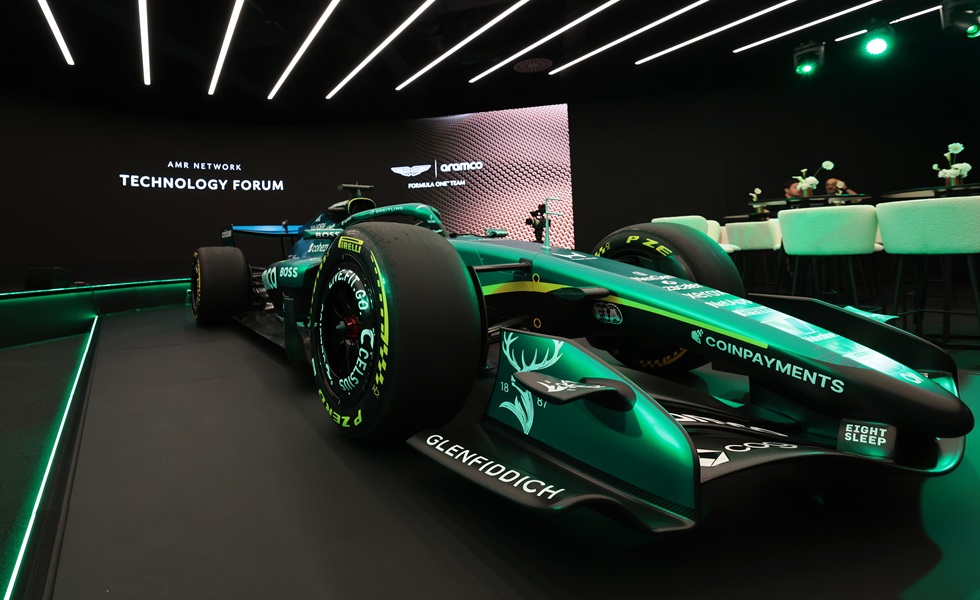
That shift was evident at Silverstone ahead of the British Grand Prix, where Aston Martin Aramco Formula One Team launched the AMR Network, a technology platform bringing together many of its AI and digital infrastructure partners to explore how advances in artificial intelligence, machine learning and high-performance computing are changing both the sport and wider industry.
Rather than announcing another technology partnership, the initiative reflects a broader evolution in how Formula One teams are approaching innovation. Increasingly, competitive advantage is being created not by a single supplier or breakthrough technology, but by ecosystems that combine expertise across cloud computing, AI, cybersecurity, data infrastructure and enterprise software.
Partners including CoreWeave, Cohere, ServiceNow, Cognizant, Cognition, NetApp, Zscaler, Arm, Xerox and Eight Sleep joined the inaugural forum, with discussions centred on how AI is influencing engineering, operational performance and decision making.
AI is becoming another member of the engineering team
Formula One has always relied on data, but the sheer volume and complexity now being processed means artificial intelligence is becoming an increasingly important analytical tool rather than simply another layer of automation.
According to Aston Martin Aramco, each race weekend generates around 50 billion sensor data points per car. Every lap produces approximately 180MB of combined vehicle and garage data, while around 450 million data points can be processed every second through multiple layers of calculation and simulation. Between 50 and 100 real-time decisions are made on every lap using live race information.
Speaking during the Technology Forum, Team Principal Adrian Newey said the team’s use of AI is considerably more specialised than many people assume. “Most people think of AI as pattern recognition combined with an internet search,” he said. “What we’re doing is using AI and machine learning in very specialised roles that don’t rely on the internet at all. We’re feeding in our own data, from the wind tunnel, CFD and the track, and using AI to spot patterns, correlations and trends that a human might not see quickly enough. It helps us make better decisions about how to develop the car.”
He added that one of the biggest challenges remains replicating human intuition. “The really interesting challenge is trying to give it something approaching intuition. Humans are very good at seeing patterns and making leaps, but that is the hardest thing to define and encode. That is the frontier we are working on.”
Building an AI ecosystem rather than buying individual tools
One of the more significant themes emerging from the forum was that AI is increasingly dependent on integration rather than isolated applications.
The AMR Network spans multiple technology layers, from Arm’s AI computing platform and CoreWeave’s cloud infrastructure through to NetApp’s data storage, Cohere’s generative AI models, Cognition’s autonomous software development, Zscaler’s cybersecurity platform and ServiceNow’s enterprise workflows. Together they support engineering, operations and race strategy rather than functioning as standalone technologies.
Jefferson Slack, Managing Director, Commercial at Aston Martin Aramco Formula One Team, said the pace of change created by AI is unlike anything the sport has previously experienced. “Formula One has always been at the forefront of technological innovation, but the pace of change we are seeing through artificial intelligence and advanced computing is unlike anything the sport has experienced before,” he said. “Together, these organisations represent an extraordinary collection of expertise across AI, data, cloud computing, enterprise technology, security and human performance. The AMR Network enables us to continue those conversations throughout the season, creating meaningful opportunities for collaboration and thought leadership across our partner portfolio.”
The discussions also highlighted challenges that extend well beyond motorsport. Security specialists argued that AI agents introduce entirely new digital identities requiring protection, while infrastructure providers emphasised that the value of AI depends on moving and processing vast quantities of data quickly enough to support real-time decision making. Other participants pointed to AI’s growing role in operational workflows, software development, engineering collaboration and human performance.
For Formula One, these technologies remain focused on winning races. However, the significance of the AMR Network lies in what it represents for industry more broadly. As AI matures, competitive advantage is likely to depend less on access to individual models and more on how effectively organisations connect computing infrastructure, data, security and specialist expertise into a coherent operating ecosystem.
That may ultimately prove to be one of Formula One’s next contributions to enterprise technology: demonstrating that the future of AI is not simply faster algorithms, but better collaboration.