
The economics of artificial intelligence are changing how data centre developers measure construction performance. Completing a facility on budget remains important, but the time taken to bring computing capacity into operation is becoming an increasingly significant factor in determining its commercial value.
Vertiv and NVIDIA have developed an approach intended to shorten that period by combining pre-engineered infrastructure designs, digital simulation and factory-built construction. Under defined modelling assumptions, the companies estimate that this could generate up to 30 per cent more cumulative AI token output during the first 12 months, without increasing installed computing capacity.
The proposal reflects a shift in how AI infrastructure projects are evaluated. Delays in commissioning power, cooling and supporting systems can leave computing equipment unavailable for productive workloads, even when the underlying hardware has been secured.
The approach combines NVIDIA’s Vera Rubin DSX AI Factory reference design with Vertiv’s power and cooling infrastructure models, using NVIDIA Omniverse and Dassault Systèmes’ 3DEXPERIENCE platform to configure and validate facilities before construction.
Rather than engineering individual systems separately, the intention is to resolve integration requirements within a shared virtual environment. Vertiv says this could reduce the configuration and validation period from approximately 30 days to three days in its modelled scenario.
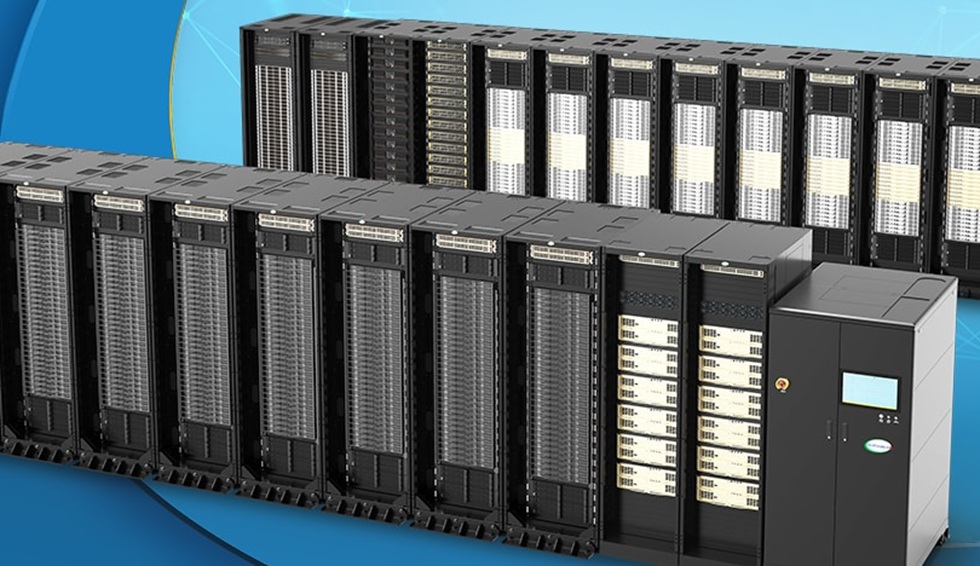
Prefabrication provides the second element. Vertiv’s OneCore and SmartRun systems move more power distribution, liquid cooling and supporting infrastructure assembly into factories, reducing the amount of integration required on-site.
According to the companies’ modelling, this could shorten infrastructure deployment from 90 days to 45 days. Combined with faster design validation, the two stages could fall from approximately 120 days to 48 days, making productive computing capacity available around ten weeks earlier.
These figures are modelled estimates rather than demonstrated outcomes across completed projects. The potential 30 per cent increase in cumulative token output similarly depends on the stated assumptions and earlier availability of otherwise identical computing capacity.
A practical application is emerging at Polar Data Centers’ Herøya campus in Norway, where Vertiv is supplying prefabricated power and thermal modules for the first 41MW phase of a development designed to scale to 100MW.
Polar is also deploying Vertiv’s SmartRun overhead infrastructure, SmartMod modular systems and Unify software. The project provides an example of the factory-built deployment approach, although the announcement does not establish that the modelled time savings have been achieved at the site.
The wider significance is the growing relationship between construction schedules and AI computing economics. Traditional data centre development has concentrated on delivering reliable capacity, while AI factories introduce additional pressure to make that capacity productive as quickly as possible.
For developers, standardised designs and factory integration could reduce uncertainty during complex deployments. However, the benefits remain dependent on site conditions and the practical execution of individual projects.
As AI investment accelerates, the ability to bring infrastructure into operation earlier may become an increasingly important measure of data centre performance, alongside energy efficiency, resilience and capital cost.