
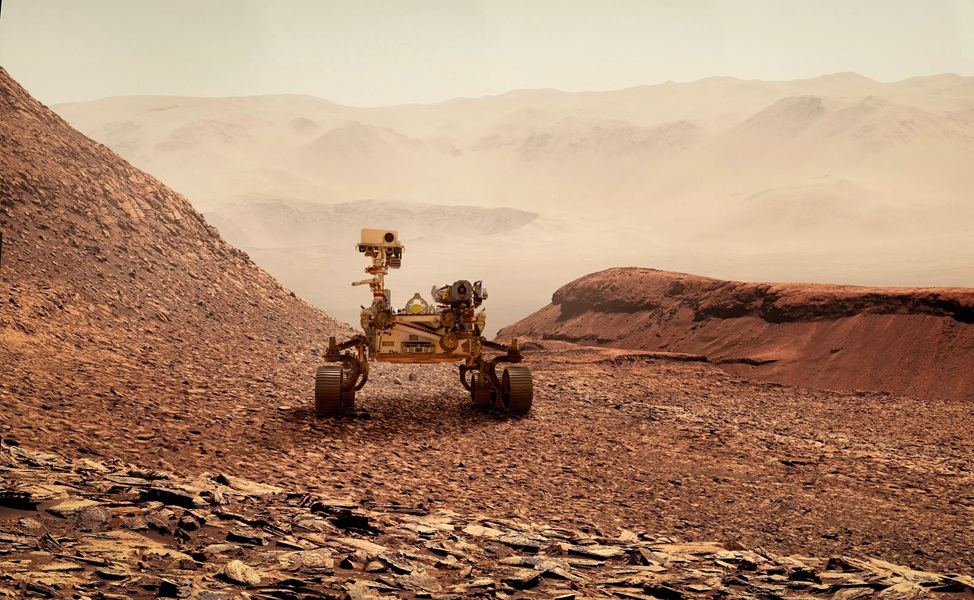
For most of its history, planetary exploration has been shaped by delay. When engineers on Earth send instructions to Mars, it takes roughly twenty minutes for the signal to arrive. By the time a command reaches a rover, conditions may already have changed. That time lag has forced NASA to rely on painstaking human planning, issuing carefully sequenced instructions and waiting hours or days to see the outcome.
In December 2025, that dynamic shifted slightly, but significantly. For the first time, a section of a rover’s journey on another planet was planned by an artificial intelligence system rather than a human operator. Engineers at NASA’s Jet Propulsion Laboratory used Anthropic’s Claude model to help chart a route for the Perseverance rover across a rocky stretch of the Martian surface.
The distance was modest, around four hundred metres, roughly the length of a running track. But the implications extend far beyond how far the rover travelled.
Why driving on Mars is still hard
Perseverance has been operating on Mars since February 2021, exploring the Jezero crater, a site chosen because evidence suggests it once contained water and may have supported microbial life. The rover’s objectives range from studying the planet’s geology and climate history to collecting rock and dust samples that could eventually be returned to Earth.
Getting the rover from one point to another is a high-risk exercise. Wheels can lose traction, slopes can prove unstable, and fine sand can trap a vehicle permanently. In 2009, the Spirit rover became immobilised after driving into a sand trap, ending its mission.
To avoid such outcomes, rover drivers traditionally construct what they describe as a breadcrumb trail. Using orbital images and photographs taken by the rover itself, human planners define a series of waypoints, often ten metres apart, which the rover then follows autonomously. Once the plan is complete, it is transmitted across the 362 million kilometres between Earth and Mars via the Deep Space Network.
Perseverance does have an onboard AutoNav system to avoid obstacles between waypoints, but it can only react to what it sees immediately ahead. Longer-range planning has always remained a human task, until now.
How an AI learned to plan a Martian route
To test whether that work could be partially automated, engineers at NASA Jet Propulsion Laboratory integrated Claude into their planning process. The AI was not asked to generate a route in isolation. Instead, engineers provided it with extensive context drawn from years of operational experience, including constraints, best practices and prior driving data.
Using its vision capabilities, Claude analysed overhead images of the terrain and wrote commands in Rover Markup Language, an XML-based language developed for earlier Mars missions. It plotted a sequence of ten-metre segments, then iterated on its own output, critiquing and refining the waypoints.
The proposed route was then subjected to the same validation process used for human-generated plans. More than 500,000 variables were simulated to predict the rover’s position and identify potential hazards. When engineers reviewed the AI-generated plan, they made only minor adjustments, largely based on ground-level images the model had not seen. The route was approved, transmitted and successfully executed on Mars on December 8 and 10.
NASA estimates that using Claude in this way could halve the time required to plan rover drives, freeing up engineers to schedule more journeys and focus more on scientific analysis rather than manual route design.
A glimpse of autonomous exploration
The experiment is modest in scope, but its significance lies in what it suggests about future missions. The capabilities demonstrated by Claude, understanding unfamiliar environments, writing operational code and making constrained decisions with limited supervision, align closely with what will be needed as missions grow more ambitious.
NASA’s Artemis program aims to return humans to the Moon and establish a sustained presence near the lunar south pole. That effort will demand efficient use of time and resources, and greater autonomy for both machines and systems supporting astronauts.
Further ahead, missions to more distant destinations will face even longer communication delays, harsher environments and tighter energy constraints. In such settings, waiting for instructions from Earth may simply be impractical.
Claude’s four-hundred-metre drive does not herald fully autonomous space exploration. But it offers an early indication that artificial intelligence may one day help robotic explorers make fast, adaptive decisions far beyond Earth, navigating environments where human guidance arrives too late to matter.