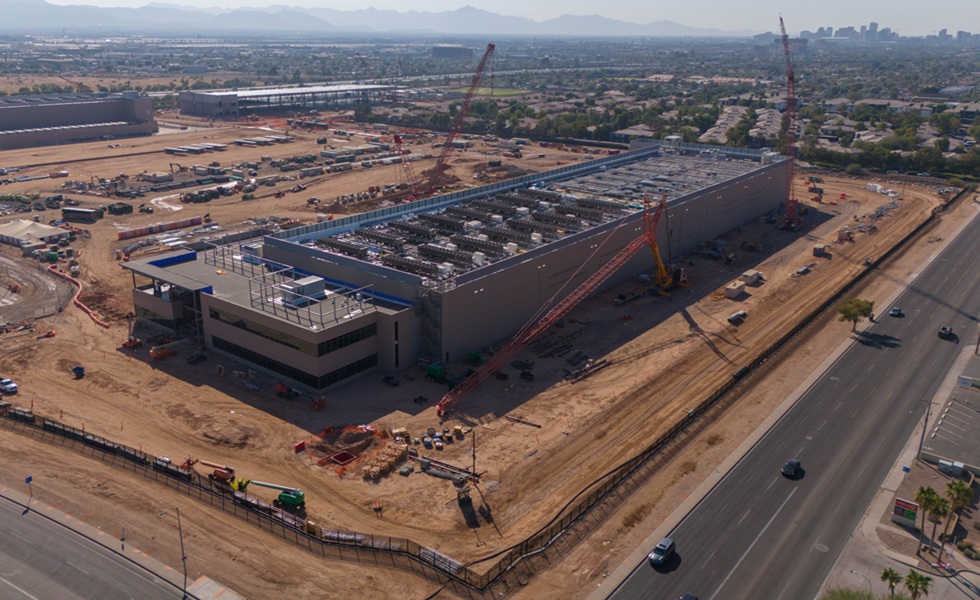
As AI workloads grow denser and data centres reach physical limits, the real bottleneck in the AI revolution is not chips or power, but heat. The next phase of compute may depend on how effectively we learn to move it.
When people talk about artificial intelligence at scale, the conversation almost always turns to compute. Every headline hails the arrival of faster chips, denser clusters, and new GPU architectures promising exponential performance. But for every watt of energy that drives that performance, there is an equal measure of heat that must be removed. The problem is, we have reached a point where traditional methods no longer work.
In the past, engineers could simply scale cooling systems in proportion to the servers they supported. Fans grew larger, airflow became more intense, and mechanical systems became more complex. The logic seemed unbreakable: more power meant more air. Yet AI has shattered that logic. Today’s advanced GPUs draw more than 1,500 watts each, and the next generation will exceed 2,000. Cooling with air is now like trying to douse a forest fire with a garden hose.
For Shahar Belkin, Chief Evangelist at ZutaCore, this is more than a technical challenge; it is the hidden crisis of the AI age. “The ability to move heat away with air does not exist anymore because it is either too expensive or requires massive, inefficient systems,” Belkin explains. “If we do not rethink cooling from first principles, we will reach a point where silicon can no longer advance.”
Executives may assume that thermal management sits in the engineering domain, but the scale of this challenge has elevated it to a strategic issue. The limitations of heat transfer are now shaping boardroom decisions about cost, sustainability, and capacity planning. Every future data centre project, whether at hyperscale or at the edge, must account for how much heat can be moved and how much power can be delivered.
Cooling as a strategic priority
Cooling has long been viewed as the plumbing of digital infrastructure, an operational necessity rather than a differentiator. Yet, in the context of AI, it has become one of the most critical enablers of growth. As data centres evolve into AI factories housing megawatts of compute per hall, the question of how to safely and efficiently remove that energy determines whether expansion is even possible.
Belkin explains that the shift from air to liquid cooling is no longer theoretical but inevitable. Direct-to-chip liquid cooling, where coolant comes into direct contact with the processor, allows operators to achieve far higher density while consuming far less energy. “It is not a matter of preference,” he says. “The industry has simply reached the physical limits of what air can do.”
But even within liquid cooling, there are critical distinctions. The first, known as single-phase cooling, relies on absorbing heat into the liquid and transporting it away. This works effectively up to a certain thermal threshold, but beyond that, the volume and pressure required to maintain performance become unmanageable. Two-phase cooling, in contrast, uses a change of state, boiling, to remove heat far more efficiently. When a liquid turns to vapour, it absorbs a vast amount of energy without increasing its temperature, allowing for almost unlimited heat transfer within compact systems.
“The beauty of boiling is that the temperature remains constant regardless of how much energy you add,” Belkin explains. “The liquid itself becomes the protector, removing heat through a natural and almost unlimited mechanism. It is physics, not engineering, that makes this possible.”
From waste heat to value creation
The implications of this approach go far beyond operational efficiency. In a two-phase cooling system, the heat that leaves the chip is carried in high-grade vapour, which can be redirected, reused, or even monetised. Traditional water-based systems produce lukewarm fluid that rapidly cools and is difficult to transport. Vapour, by contrast, retains its heat over longer distances, enabling entirely new models of energy management within and beyond the data centre.
Belkin sees this as the next frontier for sustainable design. “When you reclaim heat, you are saving real money,” he explains. “You can use it to offset your own cooling costs, to warm adjacent buildings, or to power absorption chillers that help regulate temperature elsewhere. The more efficiently you recover heat, the more resilient and self-sufficient your data centre becomes.”
This concept, turning thermal waste into usable energy, is already transforming discussions around sustainability. Data centres are under growing scrutiny for their energy and water consumption, especially as AI-driven workloads push power demands into the gigawatt range. Closed-loop, waterless cooling systems offer a decisive advantage by eliminating evaporative losses and reducing the need for mechanical chillers. Instead of relying on large volumes of water or chemical refrigerants, they use ambient air via large dry radiators, lowering both costs and environmental impact.
Belkin estimates that this approach could reduce cooling costs from one dollar per dollar of compute to just six or seven cents. That difference, applied at hyperscale, equates to millions in savings while slashing energy consumption. For an industry struggling to balance growth with sustainability targets, it represents one of the most significant efficiency gains available today.
Designing simplicity into complexity
For many operators, however, the perceived complexity of liquid systems remains a psychological barrier. Phase-change cooling, with its talk of boiling, condensing, and pressure control, can sound intimidating to non-specialists. Belkin is quick to dismiss this misconception. “On paper, it looks complicated,” he says. “Then people see it installed and running, and their first reaction is, is that all? It is two tubes connected to a manifold, clean and simple.”
This simplicity has practical implications. Organisations do not need to rebuild their facilities from scratch to adopt advanced cooling. Direct-to-chip systems can be deployed incrementally, rack by rack, allowing existing air-cooled environments to coexist with liquid systems during transition. For data centres under pressure to deploy new AI workloads rapidly, that modularity removes one of the most significant barriers to adoption.
In field deployments across telecommunications, financial services, and hyperscale environments, the same pattern repeats. Operators initially approach liquid systems with caution, expecting disruption and complexity. Once installed, they find the opposite: a quieter, more stable environment with consistent thermal control and lower maintenance overheads. “When they see the figures for power efficiency and the performance stability of their GPUs, it becomes self-explanatory,” Belkin adds.
Beyond the physics, a business transformation
The transformation of cooling is not just about temperature; it is about business resilience. As AI workloads become mission-critical, stability becomes non-negotiable. In sectors such as finance, manufacturing, and autonomous systems, even minor temperature fluctuations can trigger performance throttling or hardware degradation. Keeping chips consistently within the optimal range is therefore not only an operational concern but a matter of competitive advantage.
Belkin notes that one of the earliest benefits clients report has nothing to do with power usage. It is noise. Without high-speed fans, the environment becomes dramatically quieter, improving working conditions for onsite engineers and reducing mechanical strain on equipment. But the deeper advantage is computational consistency. “When chips overheat, they drop from boost mode back to base mode to protect themselves,” he explains. “With stable cooling, you stay in boost indefinitely. That alone can deliver a measurable increase in output without touching the hardware.”
These gains extend to future flexibility. As AI compute moves beyond hyperscale campuses into modular and edge environments, the need for compact, autonomous systems will grow. Two-phase cooling is particularly well suited to these scenarios because it combines high efficiency with low dependence on external systems. It can operate without chillers, water towers, or complex environmental controls, making it ideal for smaller or remote deployments where space, power, and maintenance resources are limited.
Cooling as a service
The most profound shift, however, lies in how cooling will be delivered. Belkin envisions a future where thermal management evolves from a capital expense to a service model, mirroring the transformation of software and compute. “Most companies do not want to own hardware; they want performance,” he explains. “The same logic will apply to cooling. If a provider can guarantee uptime, reduce energy costs, and even monetise waste heat, why would you buy equipment rather than a service that delivers outcomes?”
This concept of ‘cooling as a service’ reflects a broader trend in AI infrastructure, the migration from product-based ownership to performance-based contracting. It also aligns with the growing demand for flexibility as hardware evolves at an unprecedented speed. Buying fixed systems to last a decade no longer makes sense when chip designs double in thermal output every few years. Leasing or outsourcing cooling capacity could allow organisations to upgrade at the same pace as silicon innovation.
Belkin likens the change to the early days of cloud computing. “Nobody believed enterprises would give up their own servers,” he says. “Now almost every company operates in the cloud. Cooling will follow the same path once executives realise it can be more efficient, adaptable, and sustainable.”
The physics of the future
For decades, the technology industry has been governed by Moore’s law, the idea that computational capacity doubles roughly every two years. But as transistor scaling approaches physical limits, another law is emerging: the law of heat. The more powerful our systems become, the harder it is to move the energy they release. That constraint may prove to be the defining boundary of AI’s future.
Belkin warns that without a step change in cooling technology, silicon innovation could stall entirely. “If cooling does not move at the speed of silicon, the industry will eventually stop,” he concludes. “The chip manufacturers already see this. They can design ever more powerful processors, but they cannot remove the heat fast enough. At that point, progress halts, not because we lack ideas, but because we cannot move heat efficiently enough.”
The AI revolution is often described in terms of algorithms, compute power, and data. Yet none of those elements can exist without effective thermal management. The next wave of technological progress will be defined not only by how we compute, but by how we cool. As data centres evolve into intelligent energy ecosystems that harvest, redistribute, and optimise heat, cooling will no longer be an afterthought. It will be the foundation upon which the future of artificial intelligence is built.