
AI factories are redefining the architecture of digital infrastructure, transforming data into intelligence at an industrial scale and reshaping the competitive landscape for enterprises and governments alike. This article marks the beginning of our series on AI factories, setting the stage for a closer examination of the technology, economics, and environmental concerns that will shape their future.
Computing has always been measured in numbers, cycles per second, capacity in bytes, and energy in watts. That arithmetic still matters, but the acceleration of generative and agentic models has shifted the definition of progress. The old benchmarks no longer capture what is at stake. Training models with trillions of parameters is no longer an experiment for research labs. It has become a commercial imperative. To meet it, infrastructure must be rebuilt from the ground up. Out of this necessity, the AI factory has emerged, a facility designed not to serve up websites or email but to manufacture intelligence itself.
These factories are not just larger versions of data centres. They are dense, orchestrated systems where thousands of GPUs, specialised processors, high-bandwidth storage, and low-latency networking work as a single organism. Jensen Huang, founder and CEO of NVIDIA, captures the scale of the shift. “We are entering a new industrial era, one defined by the ability to generate intelligence at scale,” he says. “Together, HPE and NVIDIA are delivering full-stack AI factory infrastructure to drive this transformation, empowering enterprises to harness their data and accelerate innovation with unprecedented speed and precision.”
That sense of acceleration has consequences. The data centre has stopped being a warehouse of servers. It has become the computer.
From metaphor to operating model
Calling these environments factories is not simply a flourish. The comparison is deliberate. A manufacturing plant takes raw materials and, through a sequence of processes, transforms them into finished goods. An AI factory works the same way: data enters, is processed through complex systems of compute and storage, and emerges as models, insights, and applications.
Analysts describe them as the new industrial engines of innovation. Every stage of the AI lifecycle is handled under one roof, from ingestion and training to inference and monitoring. Instead of separate silos, the components are designed to work together, optimised to keep bottlenecks at bay and maintain a continuous flow of intelligence. The language of production applies neatly: throughput, quality control, continuous refinement.
Governments have recognised the importance of this shift. The European Commission has made AI factories a strategic priority, committing to build at least fifteen by 2026, along with a series of AI-optimised supercomputers. To finance the next leap, the InvestAI Facility will provide €20 billion for as many as five gigafactories, each equipped with more than 100,000 advanced processors. These will not just be bigger versions of current data centres. They will emphasise energy efficiency, secure supply chains, advanced networking, and sovereign control of data.
Seen in this light, the AI factory becomes not just infrastructure but a political and economic instrument. It ties together compute, compliance, sovereignty, and industrial policy.
Competition is measured in factories
The emergence of AI factories is reshaping how competitiveness is measured. For nations, they are becoming assets on the same level as ports, power grids, or transport hubs. For enterprises, they mark the line between ambition and execution.
Antonio Neri, president and CEO of Hewlett Packard Enterprise, underlines the stakes. “Generative, agentic and physical AI have the potential to transform global productivity and create lasting societal change, but AI is only as good as the infrastructure and data behind it. Organisations need the data, intelligence and vision to capture the AI opportunity, and this makes getting the right IT foundation essential.”
The framing of AI factories as a new unit of competition is already influencing investment. Governments are treating them as critical infrastructure, essential for sovereignty and resilience. Enterprises are calculating whether they can afford to build, whether to lease, or whether to rely on federated access. Smaller organisations are asking what kind of access model will allow them to compete without bearing the full cost of construction.
Vendors have begun to categorise factories into types. Some are turnkey, aimed at enterprises that want an integrated, on-premises platform with predictable performance. Others are scaled to serve service providers and model builders, offering multi-tenant training and inference across large workloads. Still others are sovereign, designed for governments and critical sectors that need independent capacity and strict regulatory compliance. The distinctions highlight that this is no longer a uniform market. Different users require different factories, tailored to their role in the AI economy.
Complexity as design, not flaw
What sets AI factories apart is not only scale but the way they are stitched together. Training today’s large models is not a matter of raw power concentrated in a single chip. It is the orchestration of thousands of processors, synchronised across a fabric of connections.
NVIDIA has described this complexity as the defining feature of the new paradigm. If the networking is not configured with precision, the system can stall. Get it right, and performance leaps ahead. Training workloads depend on collective operations that aggregate or exchange data across every node. Inference workloads, by contrast, demand instant responsiveness in multi-tenant environments without interference between applications. Neither task can be served by networks designed for web traffic.
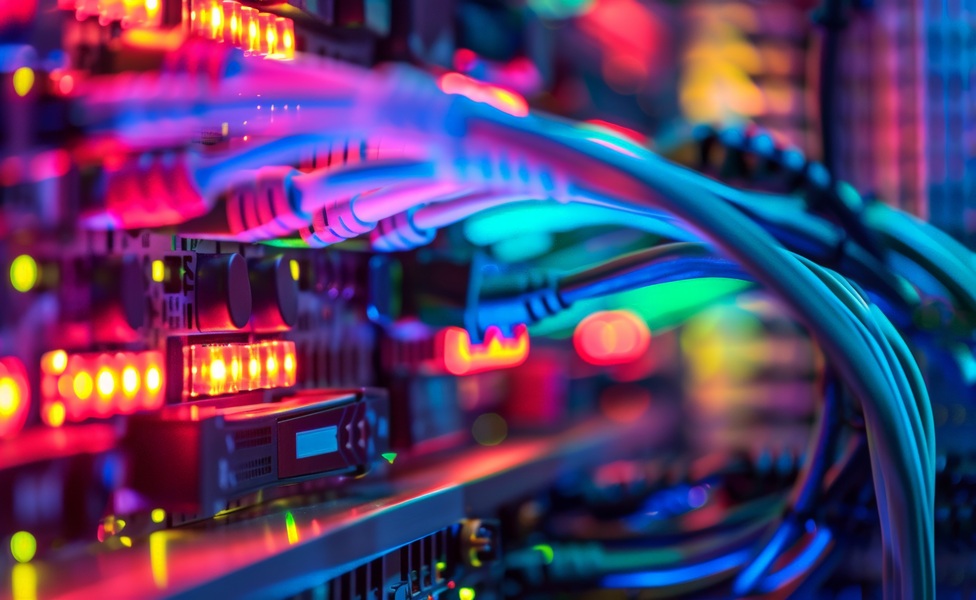
This is why the physical architecture has transformed. Racks are no longer filled with lightweight machines. They are built around heavy copper spines, liquid-cooled manifolds, and dense busbars. The demands of training and inference at this scale push energy requirements into the gigawatt range. The AI factory is therefore not only a computational challenge but an energy one, a site where computing meets industrial engineering.
The question of deployment
Enterprises considering how to engage with this model face decisions that go well beyond IT strategy. A self-hosted factory offers control and sovereignty, but it comes at an enormous capital cost. Cloud-hosted models provide scale and flexibility, but at the risk of dependency. SaaS-style inference platforms allow fast integration without managing infrastructure. At the same time, edge-based deployments bring intelligence closer to where data is created, reducing latency for industries that need real-time decision-making.
Each approach has advantages and limitations. Self-hosting offers independence, but it demands a deep technical expertise. Cloud hosting provides elasticity but ties an enterprise to the roadmaps of its providers. Edge computing reduces reliance on networks but requires strong local systems. The choice is not purely technical. It reflects priorities in sovereignty, speed, flexibility, and resilience.
The thread running through them is continuity. AI cannot be treated as a one-off project. It must be maintained, retrained, and scaled. Factories give organisations the structure to industrialise this cycle.
Sustainability and resilience
Energy is the most obvious constraint. Training a single large model can consume the equivalent electricity of a small town, and inference at a global scale adds a constant load. The European Commission has made efficiency central to its gigafactory plans, insisting that sustainability and renewable integration cannot be an afterthought.
Vendors are pursuing innovations to address the issue. Direct liquid cooling reduces the energy used for thermal management. Silicon photonics promises higher bandwidth at lower power. Smarter scheduling and workload optimisation reduce unnecessary consumption. These techniques are not fringe considerations but central to the viability of the factory model.
Resilience is broader than power supply. Supply chains for AI factories are vast and fragile, reliant on advanced chips, networking equipment, and specialised cooling components. Any disruption can derail national strategies or corporate roadmaps. For this reason, governments are classifying AI factories as strategic assets, protecting them alongside energy infrastructure and transport corridors.
Trust and governance are also part of the equation. Europe is embedding compliance and transparency into the very architecture of its factories. The aim is not just capacity but trustworthy capacity, aligned with the principles of the AI Act. That focus is likely to spread as regulators elsewhere demand greater accountability in the design and operation of AI infrastructure.
Factories as strategy
For executives, the AI factory is not only a technical concept but a strategic framework. It invites leaders to think of data as raw material, infrastructure as machinery, and intelligence as the output. It requires decisions about ownership, partnerships, and regulation. These are questions for the boardroom, not just the IT department.
It also signals a cultural shift. AI factories imply continuous investment, not discrete projects. They demand collaboration across business units, regulatory awareness, and a willingness to strike a balance between short-term goals and long-term sustainability. Those who see them as production systems will be positioned to innovate repeatedly. Those who view them as projects risk being overtaken.
Huang has emphasised the pace of change. “In no time in history has computer technology moved faster than Moore’s law,” he has observed. “We are moving way faster than Moore’s law and are arguably easily Moore’s law squared.” AI factories are the physical manifestation of that acceleration. They embody the new speed of progress.
The road ahead
The direction is set. AI factories are consolidating hardware, software, and data pipelines into coherent production systems. They are already reshaping strategies for enterprises, cloud providers, and governments. They are altering the balance of global competition.
The real questions now are practical. Should an enterprise prioritise sovereignty, flexibility, or speed? How will governments balance investment with sustainability? What role will cloud providers play in serving workloads that demand orchestration at scales never before attempted?
The answers will vary, but one fact is consistent: AI factories are not optional. They are the crucibles in which the future of business and society will be forged.