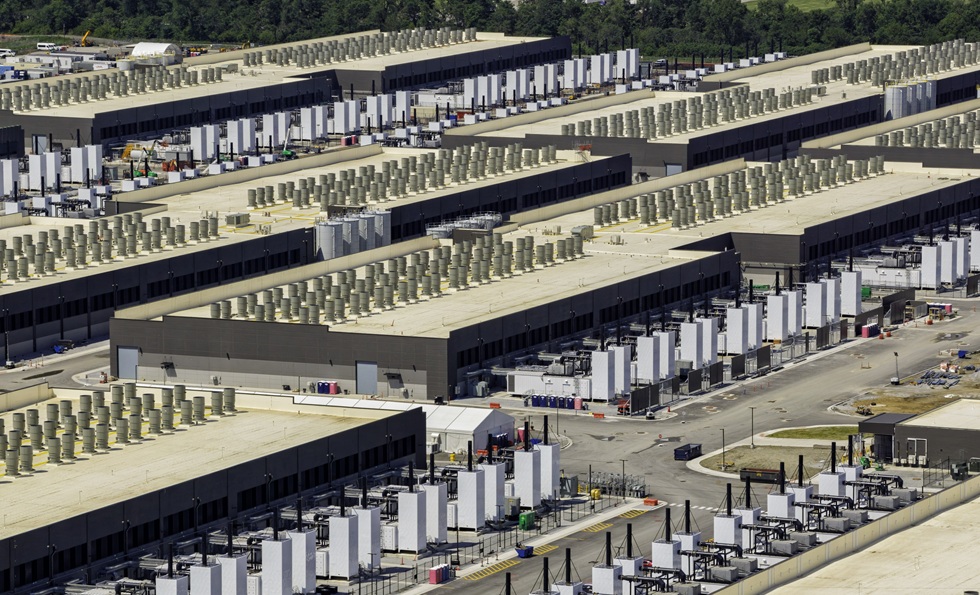
Artificial intelligence is accelerating faster than the infrastructure built to sustain it. As the world races to scale compute, a new question emerges, one with consequences that reach far beyond data centres. How do we build an intelligent economy when the physical footprint of that intelligence is already straining the limits of energy, water, materials, and climate resilience?
Executives often speak about AI in abstract terms, as if intelligence sits somewhere above the material world. Yet every model, every training cycle, every inference request ultimately depends on a landscape of metals, land, heat, and electricity. AI is not weightless. It is an industrial system disguised as software. That tension, between digital promise and physical consequence, has become one of the most important strategic challenges of the decade.
Many organisations still treat sustainability as a reporting exercise or a compliance obligation. However, the forces shaping the next generation of AI infrastructure are more structural than reputational. Power grids are congested. Water scarcity is intensifying. Heat islands around major metros are growing. Public pressure around environmental stewardship is beginning to influence permitting and investment decisions. The old equilibrium no longer holds.
Gabriel Lazar, ESG Sustainability Specialist, at Submer captures this shift plainly. “We are no longer talking about incremental improvements,” he says. “The size of the models, the density of the hardware, and the speed of deployment mean that sustainability is not a side topic. It is a limiting factor. The organisations that recognise this early will shape the pace and quality of global AI adoption.” His observation is neither rhetorical nor idealistic. It reflects a structural reality: AI’s growth curve collides directly with the physical world’s constraints.
Why today’s infrastructure model cannot carry tomorrow’s demand
The data centre sector has been expanding for two decades, but the current AI wave has introduced a different order of magnitude. Training clusters that once required megawatts now demand tens or even hundreds. Estates built for mixed workloads are being redesigned around concentrated heat loads. Cooling strategies that were adequate five years ago are now insufficient. Even the geography of deployment is shifting, as operators search for grid capacity, cooler climates, or political environments more tolerant of rapid development.
However, the problem is not simply scale. It is the distribution of that scale. Power consumption is becoming increasingly concentrated in smaller footprints, pushing heat density beyond the range that air-based cooling can manage. As Lazar explains, “High-density racks are no longer exceptions; they are becoming the baseline for AI training. The infrastructure model built for the cloud era cannot absorb what the AI era demands unless it changes its thermal assumptions.” That thermal shift reshapes everything from site selection to mechanical design and long-term financial planning.
There is also a temporal dimension. AI deployments are being rolled out faster than grid operators, water authorities, and regulators can respond. Many hyperscale expansion plans are already colliding with local opposition, often because communities see data centres as large engines of electricity consumption without corresponding public benefit. In regions where water scarcity is acute, evaporative cooling is coming under scrutiny. The result is a patchwork of restrictions, approvals, and renegotiations that can delay or derail major projects.
The constraints are not theoretical. They define the business model. The next decade of AI infrastructure will be shaped by the organisations that can build highly dense, low-impact, resource-efficient environments without waiting for external conditions to change.
The unseen material footprint of intelligence
The environmental debate around AI has often focused on electricity consumption, yet power is only one part of the story. The embodied carbon of construction materials, chip manufacturing, and cooling systems often exceeds the emissions generated during operation, especially in the early years of a facility’s life. Meanwhile, traditional metrics such as PUE, while useful, do not capture the full spectrum of a data centre’s climate burden.
Lazar emphasises this broader perspective. “PUE tells you about energy efficiency, but it does not tell you about how much water you consume, how you source your electricity, what materials you use, or what your long-term environmental footprint looks like. We need a multidimensional approach if we want AI infrastructure to scale without creating new forms of ecological stress.” His argument reframes sustainability not as a checkbox but as a strategic design discipline.
This is particularly relevant for organisations trying to balance rapid AI deployment with net-zero commitments. The mismatch between digital ambition and climate responsibility is becoming harder to justify. Policymakers are responding. Investors are responding. Communities facing resource constraints are responding. The most advanced AI developers are beginning to understand that the environmental footprint of intelligence must be engineered as deliberately as the intelligence itself.
A new era in cooling and the physics that will define it
If electricity is the headline issue in public debate, heat is the hidden force shaping the technical future. AI hardware converts an overwhelming percentage of input energy directly into heat, and as GPU clusters rise into the 80, 100, or 150 kW per rack range, the physics of air cooling reaches its limits. The industry knows this. Engineers feel it daily. The question is not whether the cooling paradigm must shift, but how quickly organisations can transition before bottlenecks slow deployment cycles or undermine performance.
Liquid cooling, once considered niche, is now at the centre of strategic conversations. Not because of fashion or marketing pressure, but because thermal limits leave no alternative. Submer’s research, echoed across the wider engineering community, shows that immersion systems can dramatically reduce cooling energy, free up floor space, and eliminate many of the mechanical complexities that drive operational risk. These are not incremental optimisations; they are structural shifts.
Lazar describes the change clearly. “Liquid cooling is not only about efficiency,” he explains. “It is about enabling density, reliability, and predictability. When you remove air from the equation, you remove a variable that has shaped data centre design for decades.” His point goes beyond technology preference. It underscores a deeper truth about architectural freedom. When cooling is no longer the limiting factor, designers gain room to rethink how compute, storage, and networking are organised.
However, adoption is uneven. Many operators still hesitate, either due to concerns about retrofitting, lack of in-house expertise, or uncertainty about long-term maintenance. Yet the direction of travel is unmistakable. Cooling is about to become the defining engineering challenge of the AI era, and organisations that fail to anticipate this shift will find themselves trapped by the physics they ignored.
Sustainability as a strategic operating model, not an audit category
The most mature organisations are beginning to recognise that sustainability is not a downstream activity. It is an operating model, with architectural consequences that affect every layer of AI deployment. Treating it as a reporting exercise misses the point. Sustainable infrastructure is faster, more resilient, easier to scale, and financially more predictable. It allows organisations to build with confidence, rather than relying on assumptions about future grid capacity or regulatory tolerance.
Lazar puts the argument plainly. “Sustainability is no longer an environmental statement. It is a business strategy. It determines which projects can be built, how quickly they can be expanded, and how resilient they are to shocks in energy or water markets.” That framing changes the conversation entirely. The question is no longer whether sustainability matters, but how directly it affects competitiveness.
Consider the operational advantages: reduced cooling overheads, higher rack densities, optimised heat reuse, lower risk exposure, and smoother regulatory pathways. These are not moral gains. They are economic ones. They allow AI developers to deliver more compute per square metre, per kilowatt, per dollar invested. They reduce the volatility that has begun to threaten large-scale AI programmes.
As AI becomes the backbone of global industry, sustainable engineering becomes synonymous with operational continuity. Efficiency is no longer a virtue. It is a requirement.
Planning for a future shaped by intelligence, not inertia
The next generation of AI infrastructure will not be built by following inherited blueprints. It will be shaped by the organisations willing to rethink the fundamentals: how heat is managed, how materials are selected, how water is used, how power is generated and distributed, how sites are chosen, and how the entire lifecycle of a facility is understood. The challenges are complex, but the consequences of inaction are more complex still.
The organisations that succeed will be the ones that view sustainability not as a trade-off but as an engineering advantage. They will move beyond symbolic targets and build systems that align computational scale with environmental reality. They will understand that the intelligence economy depends not only on algorithms or GPUs but on the physical world’s ability to support them.
The future will not belong to the fastest builders, but to the most deliberate ones.