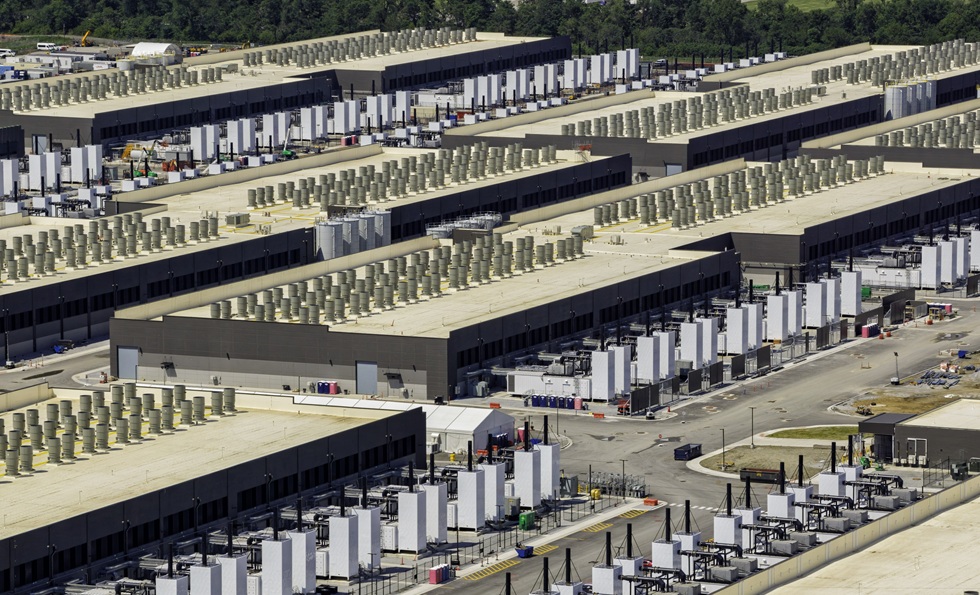
The United Kingdom’s ambitions in artificial intelligence are increasingly being shaped not by breakthroughs in models or applications, but by the physical constraints of energy, land, and compute capacity. A growing body of industry insight suggests that while policy attention remains focused on innovation, the underlying infrastructure required to support AI is failing to keep pace.
According to research published in April and cited by Matt Hawkins, founder and chief executive of CUDO Compute, nearly half of AI-first organisations report that infrastructure is not keeping up with investment in graphics processing units. A third of the 700 leaders surveyed identified energy costs as a direct constraint on their ability to expand AI operations.
The findings point to a widening disconnect between the rapid scaling of AI capability and the slower evolution of the systems required to support it. While demand for compute continues to rise, the availability of power and the complexity of planning processes are emerging as decisive factors in determining where AI workloads are ultimately deployed.
Power and planning limit growth
High electricity costs and delays in securing planning approvals are making it increasingly difficult to build and expand AI infrastructure within the UK. These constraints are not theoretical. They are already influencing operational decisions, with companies choosing to run workloads overseas where access to power and infrastructure is more readily available.
This shift has implications beyond short-term efficiency. For applications where data sovereignty and latency are critical, relocating workloads introduces new risks and dependencies. Yet for many organisations, the alternative, waiting for domestic infrastructure to catch up, is not commercially viable.
Hawkins argues that the issue is not a lack of innovation, but a failure to align infrastructure development with the pace of technological change. AI systems depend fundamentally on access to reliable power, suitable sites, and high-performance compute. Without these, advances in software cannot be translated into operational capability.
Economic consequences begin to emerge
The impact of these constraints extends into the broader economy. If compute capacity continues to lag behind demand, the risk is not simply slower adoption of AI within the UK. There is a more fundamental concern that innovation itself will migrate to regions where infrastructure is more accessible, taking investment and talent with it.
This dynamic is already visible in the global competition for AI leadership, where the availability of data centres, energy, and specialised hardware is becoming a defining advantage. The UK’s position, Hawkins suggests, will depend on its ability to accelerate infrastructure delivery and unlock private investment at scale.
The argument reflects a broader shift in how the AI race is understood. Early narratives centred on algorithms and data. Increasingly, the focus is turning to the physical systems that underpin them. Compute capacity, energy supply, and regulatory processes are emerging as the limiting factors that determine whether AI can be deployed effectively.
CUDO Compute is positioning itself within this context, building and operating large-scale AI infrastructure across the UK and Europe, including sovereign, renewable-powered GPU clusters for training and inference. The model emphasises full lifecycle control, from planning and deployment through to long-term operation, reflecting the complexity of delivering AI infrastructure at scale.
The UK, Hawkins argues, still has an opportunity to close the gap with the United States and parts of Europe. However, that window is narrowing. Without faster planning processes, more competitive energy costs, and sustained investment in compute capacity, the country risks finding that the centre of gravity for AI development has already shifted elsewhere.